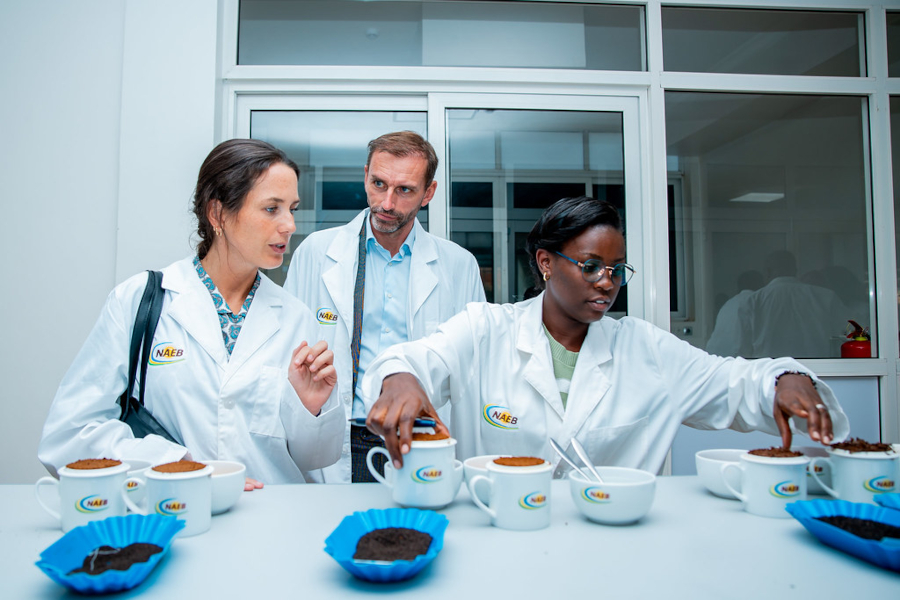
A specialized training program on the implementation of analytical methods for pesticide residue analysis was successfully conducted at National Agricultural Export Development Board Laboratory (SEQI/NAEB) Laboratory in Kigali, Rwanda.
The training was delivered with the support of development partners and technical experts dedicated to strengthening food safety systems and improving agricultural export compliance.
As the NAEB laboratory analysts were new to the instrument, the training began with a comprehensive introduction to the ULTIVO LC-MS system, including instrument startup procedures, module identification, system operation, liquid chromatography fundamentals, and ionization principles.
The program included extensive hands-on practical sessions covering routine instrument maintenance, standards preparation, equipment optimization, and analytical method development. Analysts were also trained on acquisition software and MassHunter Quantitative software for data processing and interpretation.
Training further covered international sampling protocols under CODE CAC/GL 33:1999 and international pesticide residue method validation and quality control guidelines according to DG SANTE 2021 requirements.
A robust analytical method covering 178 pesticides was successfully developed during the training. Participants performed matrix spiking exercises and achieved satisfactory recovery values, demonstrating strong technical competence. In addition, one proficiency testing sample of grapes was analyzed with results showing good agreement with assigned values from the proficiency testing provider.
To further validate the developed method, four samples collected from a pack house were analyzed, and various pesticide residues were successfully detected using the trained EN Method and developed acquisition method.
The training was conducted over three separate weeks, allowing participants sufficient time for practical application and knowledge retention. All trainees demonstrated competence in pesticide residue analysis, contributing to the strengthening of laboratory analytical capacity and food safety systems in Rwanda.